Best Food Processors Guide
The Guide · Mini Choppers for Small Jobs

One job, done in ten seconds.

A mini chopper is not a small food processor. It is a different tool for a different job: one blade, one small bowl, and nothing else to learn. We compared five current mini choppers — from a 1.5-cup single-speed to a 4-cup reversible-blade unit — on bowl size, blade design, controls and the oil dispenser some lids build in for dressings.

By Ilane Tall5 choppers comparedResearch-based — no testing lab, no invented scores

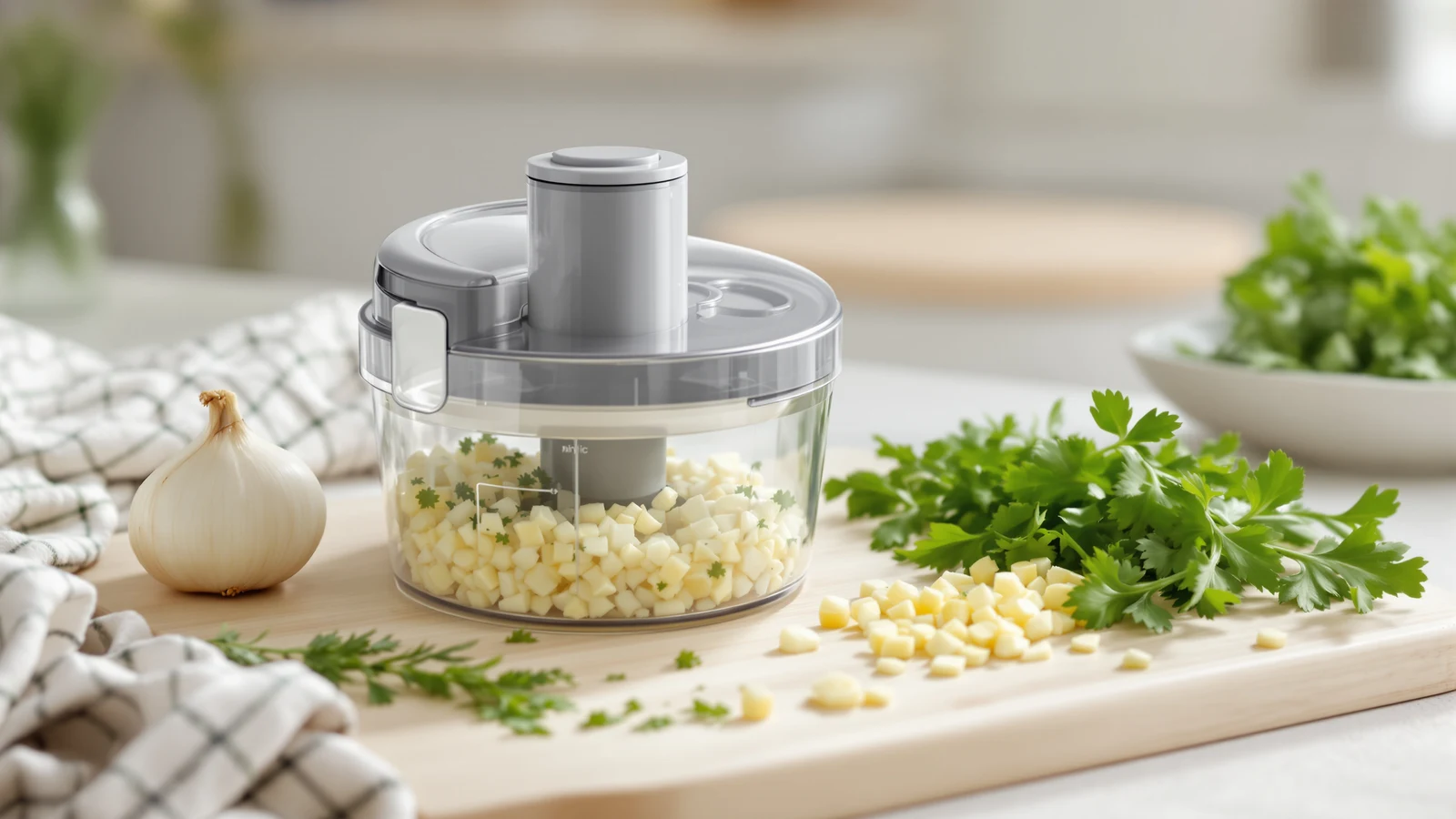
Small electric mini food chopper with a clear bowl and press-to-chop lid on a kitchen counter, surrounded by garlic cloves, a halved onion and fresh herbs

Disclosure: we're reader-supported. If you buy through a link on this page, we may earn a commission at no extra cost to you. See our About page for how we research.

The one to buy

Cuisinart Mini Food Processor, 3-Cup Reversible Blade

Of the five choppers we compared, this is the one built around a genuinely different blade. Cuisinart's SmartPower blade is auto-reversing: spin it one direction and it chops, spin it the other and it grinds, and the listing describes both modes living in the same 3-cup, 24-ounce bowl. That is one real advantage over a fixed single-direction blade — you are not relying on pulse timing alone to tell the difference between a rough chop and a fine grind.

It also sits in the middle of the group on price, well under the 4-cup Cuisinart above it and the KitchenAid at the top of the range, which makes it the pick for a buyer who wants the reversible-blade feature without paying for the largest bowl in the lineup.

The honest caveat: Cuisinart's own listing names this a mini food processor, not strictly a chopper, and like every unit here it has no slicing disc and no feed tube — it only chops and grinds whatever you drop straight into the bowl.

3-cup capacity·Auto-reversing blade·Chop and grind modes·Brushed chrome
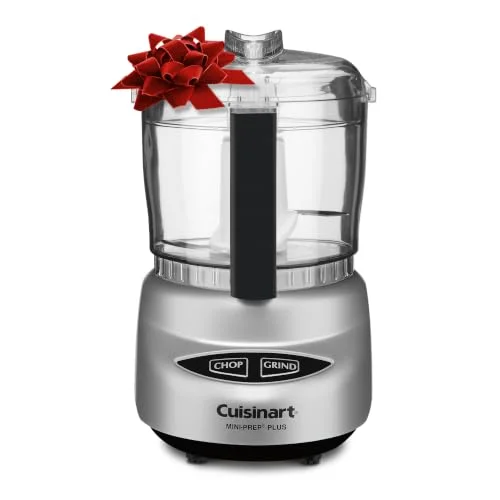
Cuisinart 3-cup mini food processor with reversible blade in brushed chrome
Price
$29.29
Check price on Amazon →

Prices change. We refresh them, but Amazon is the authority.

Before you buy

What a mini chopper does well, and what it can't do at all

A mini chopper is a single blade spinning at the bottom of a small, sealed bowl, run by a motor with no more than one or two speeds. That narrow design is the whole appeal. For garlic, a quarter onion, a handful of herbs, a small batch of hummus or a spoonful of nuts, a mini chopper is faster to set up, faster to run and faster to clean than pulling out a full-size processor — most of the units we compared have three parts total: base, bowl and lid, and the bowl itself is usually the only piece that touches food.

What it cannot do is anything that depends on a disc. None of the five choppers here include a slicing or shredding disc, and none has a feed tube, because there is no chute to drop a potato or a cucumber through — everything goes into the open bowl before the lid goes on. That rules out slaw, julienned carrots, or any job where the shape and thickness of the cut matters, not just the size of the pieces. A mini chopper also has a hard capacity ceiling: a 1.5-cup bowl listed by BLACK+DECKER will not take a large onion and still close, and even the largest 4-cup unit here is a fraction of the 11-to-16-cup range of a full-size processor built for batch cooking. If your prep regularly runs past a cup or two, or needs a slice rather than a chop, see our full food processor comparison for machines built around a feed tube and disc set.

The other limit is liquid. Every bowl here is rated in a dry cup measure, and a sealed bowl with no pour spout other than the lid makes a loose liquid like soup or batter awkward to work with in volume — these are built for solids and for small, thick mixtures like a dressing or a pesto, not for liquids on their own.

Why trust us

Why you should trust this guide

Who wrote it

Ilane Tall

Ilane Tall researches and writes the comparisons on Best Food Processors Guide. Every product here is checked against its current Amazon listing before publication, and this guide is reviewed and updated whenever a price or spec on the underlying listing changes.

How we picked

Sources, filters and exclusions

We started from current Amazon listings for compact, single-bowl electric choppers under 4 cups, pulled bowl capacity, motor wattage, blade type, speed settings and listed price for each, and set aside any listing without a stated capacity or a current price. We excluded full-size food processors, manual (hand-pull) choppers and immersion-blender attachments, because none of those share the single-bowl, single-blade design this guide is about.

Our method

How we compared them

We compared published specifications and current Amazon prices for the five mini choppers in this guide: bowl capacity in cups, motor wattage where the listing states one, blade type (fixed versus auto-reversing), the number of speed settings, and whether the lid includes a feature like an oil dispenser for emulsifying dressings. We treated capacity and wattage figures as the manufacturer states them and did not estimate or round beyond what each listing publishes. Where a listing gives no wattage or no speed count, we say so rather than guess.

We don't run a fake testing lab. We have not plugged these units in or chopped anything with them ourselves; what follows is a comparison of what each maker publishes, read carefully and cross-checked line by line.

The five

Our picks, and who each one is for

01Best overall

Cuisinart Mini Food Processor, Reversible Blade, 3-Cup Capacity

Best for chopping and grinding in the same bowl

3 cups (24 oz)·Auto-reversing SmartPower blade·Chop and grind modes·Brushed chrome

This is the only chopper in the group whose blade is described as auto-reversing: spin it one way and the listing describes a chop mode, spin it the other and it switches to grind. In a fixed-blade chopper, the difference between a rough chop and a fine grind is mostly how long you hold the pulse button; here, the direction of the blade itself changes the job, at least according to Cuisinart's own description of the SmartPower mechanism. The 24-ounce bowl sits in the middle of the sizes we compared — bigger than the BLACK+DECKER and Hamilton Beach units, smaller than the two larger Cuisinart and KitchenAid models.

The pick if you want one blade mechanism to do two different jobs, at a price well under the larger units here.
Cuisinart 3-cup mini food processor with reversible blade in brushed chrome
Price
$29.29
Check price →
02Best budget

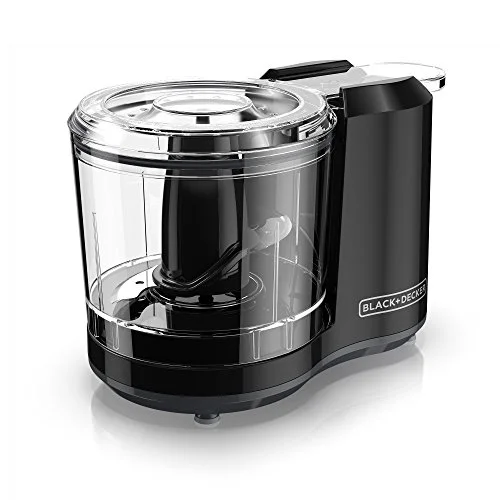
BLACK+DECKER 1.5-Cup Electric Food Chopper

Best for the smallest, cheapest jobs

1.5-cup capacity·150W motor·One Touch Pulse·Dishwasher safe

At 1.5 cups, this is the smallest bowl in the group, sized for a clove or two of garlic, a shallot, or a small handful of herbs rather than anything close to a full onion. BLACK+DECKer lists a 150-watt motor and a single One Touch Pulse control — no speed dial, no reversing blade, just press and release — and a Stay-Sharp blade that the listing describes as dishwasher safe along with the bowl and lid. It is also the lowest price of the five, which fits its role: a drawer-sized tool for the smallest, most frequent jobs, not a stand-in for a larger processor.

If your prep is one clove or one shallot at a time, this is the cheapest way to stop doing it by hand.

BLACK+DECKER 1.5-cup electric food chopper with stay-sharp blade
Price
$14.41
Check price →
03Best stack-and-press design

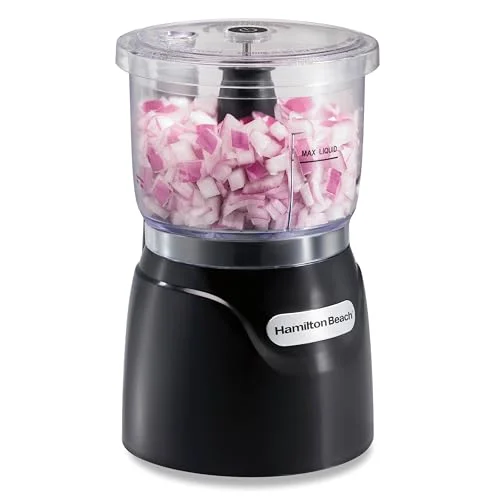
Hamilton Beach 3 Cup Electric Vegetable Chopper & Mini Food Processor

Best for a simple, no-twist-lock bowl

3-cup capacity·350W motor·1 speed·Stainless steel blades

Hamilton Beach names the assembly itself as the feature here: a "Simple Stack & Press" design, where the lid sets on top of the bowl rather than twisting to lock. The listing credits the stainless steel blades with dicing, mincing and puree, run from a single speed at a stated 350 watts — more than double the BLACK+DECKER's figure, though wattage alone does not describe a blade's sharpness or the pieces it leaves behind. Bowl, lid and blade are listed as dishwasher safe, in line with every chopper in this guide.

The pick if a twist-lock lid is the thing standing between you and actually using the chopper.

Hamilton Beach 3-cup electric vegetable chopper and mini food processor in black
Price
$18.60
Check price →
04Best larger bowl

Cuisinart Core Custom 4-Cup Mini Chopper (MCH-4)

Best for the biggest batch a mini chopper can hold

4-cup capacity·Auto-reversing SmartPower blade·Chop and grind modes·Dishwasher-safe parts

This is the largest bowl in the lineup at 4 cups, built around the same auto-reversing SmartPower blade concept as Cuisinart's 3-cup model above, with chop and grind modes in one mechanism. A 4-cup bowl is still well short of a full-size processor, but it is enough headroom for a larger batch of pesto, a bigger onion, or prepping for more than one or two servings without running the chopper twice. Cuisinart lists the parts as dishwasher-safe, matching the rest of the group.

The one to pick if 3 cups keeps running out before the job is done, without stepping up to a full-size processor.

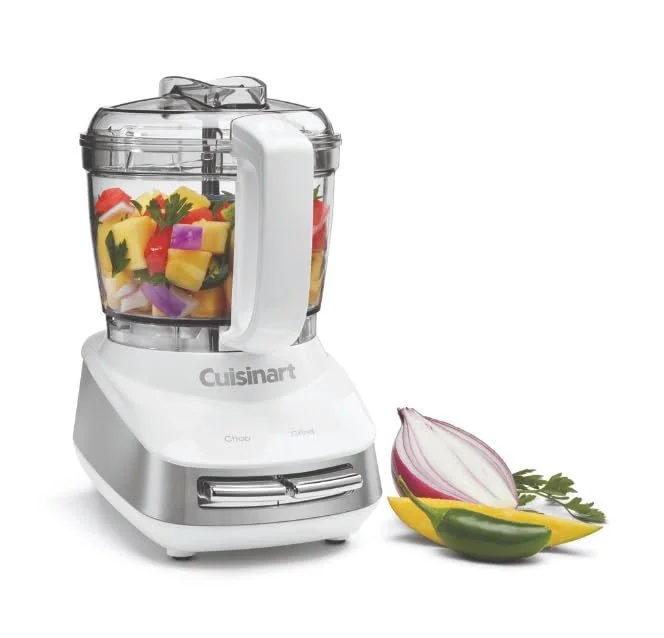
Cuisinart Core Custom 4-cup mini chopper MCH-4 in white and stainless steel
Price
$36.95
Check price →
05Best controls

KitchenAid 3.5 Cup Food Chopper KFC3516CU

Best for a chopper with real speed control

3.5-cup capacity·2 speeds plus pulse·Stainless multi-purpose blade·Easy cord wrap

Every other chopper in this guide runs on a single speed plus pulse, or pulse alone. KitchenAid's listing gives this one two speeds plus pulse, which is the most granular control in the group — useful for the difference between a coarse chop and a near-puree without relying on pulse timing by feel. The 3.5-cup bowl and stainless multi-purpose blade are listed as dishwasher-safe, and KitchenAid notes an easy cord-wrap base for storage, a small but real detail for a tool meant to live in a cabinet between uses. It is also the highest price of the five.

The pick for a cook who wants a dial, not just a button, and does not mind paying for it.

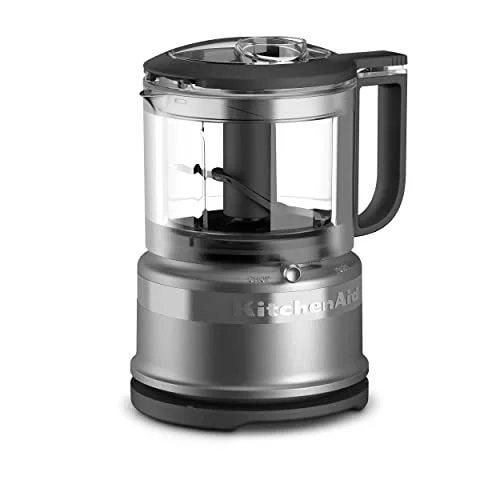
KitchenAid 3.5-cup food chopper KFC3516CU in contour silver
Price
$43.95
Check price →
Side by side

The five, compared

ChopperBest forBowlListed motorSpeeds / bladePriceGet it
Cuisinart 3-Cup Mini Chop and grind, one bowl 3 cups Not listed Auto-reversing $29.29 Get it
BLACK+DECKER 1.5-Cup Smallest, cheapest jobs 1.5 cups 150 W One Touch Pulse $14.41 Get it
Hamilton Beach 3-Cup Simple stack & press 3 cups 350 W 1 speed $18.60 Get it
Cuisinart 4-Cup Core Custom Biggest mini-chopper batch 4 cups Not listed Auto-reversing $36.95 Get it
KitchenAid 3.5-Cup Most speed control 3.5 cups Not listed 2 speeds + pulse $43.95 Get it
Capacity

Bowl sizes from 1.5 to 4 cups, translated into real prep

A cup measure on a chopper's box is a dry, level-full figure, and in practice you stop well short of the rim so the lid can close and the blade has room to move. At the small end, BLACK+DECKER's 1.5-cup bowl suits a clove or two of garlic, a single shallot, or a small handful of parsley — the jobs that take thirty seconds with a knife but still leave a cutting board to wash. Step up to 3 cups, where both the Hamilton Beach and the Cuisinart Mini-Prep sit, and a half an onion or a cup of walnuts fits with room to spare; this is the size most households reach for most often, which is also why two of the five choppers in this guide land here.

The KitchenAid at 3.5 cups and the Cuisinart Core Custom at 4 cups give you the most headroom of the group: enough for a larger batch of pesto, a whole onion, or prepping two or three servings' worth of aromatics without refilling the bowl mid-job. None of that changes what the bowl can do, only how much of it fits at once — capacity and function are separate questions, and a 4-cup bowl with a single fixed blade is still only chopping, the same job as the 1.5-cup unit, just more of it per run.

Mechanism

Reversible blades, two-speed controls and press-to-chop lids

Three different control philosophies show up across these five choppers. The simplest is BLACK+DECKER's One Touch Pulse: one button, press to run, release to stop, no speed setting to choose. Hamilton Beach's unit works the same way, with a single speed rather than a pulse-only button, which means the motor runs continuously once started rather than only while a button is held. At the other end, KitchenAid's listing gives two speeds plus pulse — the only chopper here with more than one running speed — which in principle lets you pick a slower setting for a looser chop and a faster one for something closer to a mince, instead of relying entirely on how long you hold the pulse.

The two Cuisinart models take a different approach to the same problem: instead of adding speeds, the blade itself reverses direction, and Cuisinart's listings describe one direction as a chop mode and the other as a grind mode. That is a mechanical answer to the same question two-speed control is trying to solve — how to get more than one texture out of one blade — and it is the reason we picked the 3-cup Cuisinart as the overall choice above: it is the only design in this group that changes the blade's behavior, not just its speed.

On lids: every chopper here uses a lid that must be in place and seated before the motor will run, which is a standard safety interlock on this category of appliance, though only BLACK+DECKER and Hamilton Beach's listings explicitly describe a press-to-chop or stack-and-press lid design rather than a twist-lock. If you've ever fought a twist-lock lid with wet hands mid-recipe, that detail is worth checking on the listing before you buy.

Dressings

Emulsifying dressings: oil dispensers on the lid

Making a vinaigrette or an aioli by hand means adding oil one slow drizzle at a time while whisking, because an emulsion breaks if the oil goes in too fast. A mini chopper with a lid built for this job solves the same problem mechanically: a small opening or built-in dispenser in the lid lets you add oil in a thin, steady stream while the blade runs below, without removing the lid and interrupting the emulsion. This is one of the clearest small-batch advantages a mini chopper has over a full-size food processor, whose much larger bowl and feed tube are built for bigger jobs and don't scale down well to a few tablespoons of dressing.

None of the five product descriptions in this guide name a dedicated oil-dispensing feature on their lids, so we're not attributing one to any specific unit here — if an emulsifying lid with a built-in oil opening matters to you, check the current listing's lid photos and feature bullets for that detail specifically before buying, since it is exactly the kind of feature that varies between otherwise similar choppers and between a model's older and newer listing photos.

Do you need more?

When a mini chopper is the only processor you need

If you look at what actually goes through your kitchen in a week, a mini chopper is enough on its own when most of your prep falls into three categories: aromatics (garlic, onion, ginger, shallots), small sauces and dressings in batches under a few cups, and the occasional grind of nuts, hard cheese or herbs. None of those jobs need a disc, a feed tube, or a bowl larger than 4 cups, and all of them are faster in a chopper you can rinse under the tap than in a full-size processor with a lid, blade, pusher and disc stem to disassemble and wash.

Where a mini chopper stops being enough is the moment you need a cut shape rather than a chopped texture — slaw, matchstick carrots, thin potato slices for a gratin — or a batch larger than a few cups at once, like dough or a big batch of hummus for a crowd. At that point the job calls for a disc and a feed tube, which is a full-size processor's job, not a mini chopper's. Our broader food processor comparison covers that category if your prep regularly crosses that line; most kitchens that own both reach for the mini chopper far more often, and keep the full-size machine for the handful of jobs a small bowl simply can't do.

What we left out

The competition

We set aside manual, hand-pull choppers because they are a different product category with no motor and no electrical specs to compare on equal footing, and because the pull-cord design produces an uneven chop that electric blades avoid. We also excluded full-size food processors in the 7-cup-and-up range: several, including Cuisinart's own larger models, are worth owning, but they solve a different problem — discs, feed tubes and batch size — covered in our main food processor guide rather than here. Finally, we left out immersion-blender chopper attachments, since their blade and bowl are secondary to a stick blender's main motor and are not sold or specified as standalone choppers.

FAQ

Common questions

What's the difference between a mini chopper and a mini food processor?

In practice, very little, and the terms overlap: Hamilton Beach calls its 3-cup unit both a "vegetable chopper" and a "mini food processor" in the same listing, and Cuisinart's reversible-blade models are branded "mini food processor" despite working like the other choppers here. What actually defines the category, regardless of name, is a single blade in a small sealed bowl with no disc and no feed tube. If a small-capacity unit has a slicing or shredding disc, it has moved into full-size-processor territory at a smaller scale, not chopper territory.

Can a mini chopper slice or shred vegetables?

No. None of the five choppers in this guide include a slicing or shredding disc or a feed tube, which is what a full-size food processor uses to produce uniform slices or shreds. A mini chopper's single blade only chops: it cuts whatever is in the bowl into smaller, irregular pieces as it spins, regardless of bowl size or blade direction. If you need slices or shreds, you need a full-size processor with a disc set.

What size mini chopper should I buy?

Match the bowl to your most common job, not your largest one. A 1.5-cup bowl, like BLACK+DECKER's, suits a clove of garlic or a single shallot at a time. 3 cups, where the Hamilton Beach and Cuisinart Mini-Prep sit, comfortably fits a half onion or a cup of nuts. The 3.5-to-4-cup range, covered here by the KitchenAid and the Cuisinart Core Custom, gives the most headroom for a larger batch of pesto or dressing without needing a second run through the bowl.

Is a reversible blade better than a fixed blade for chopping?

It depends on what you need from one tool. A fixed blade only chops, and texture is controlled by pulse timing alone. An auto-reversing blade, like the one Cuisinart lists on its 3-cup and 4-cup mini choppers, adds a second mode described as grinding when the blade spins the opposite way, which can be useful for hard cheese, nuts or spices without buying a separate grinder. If you only ever chop vegetables and herbs, a fixed-blade chopper does that job just as well at a lower price.

Are mini choppers dishwasher safe?

The bowl, lid and blade are listed as dishwasher-safe on every chopper in this guide, which is one of the category's biggest advantages over a full-size processor with more parts to disassemble. The motor base itself is never dishwasher-safe on any electric appliance in this category — wipe it with a damp cloth and keep it away from standing water, since the motor and controls sit inside it.